

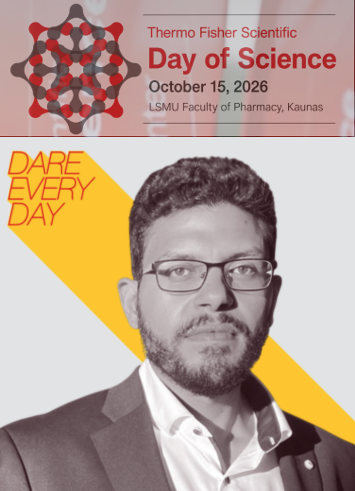
This question will be at the centre of Dr Hesham El Abd’s keynote at the Thermo Fisher Science Day in Kaunas in mid-October 2026. His talk, “From HLA Genetics to Antigen Discovery: Decoding Immune-Mediated Inflammatory Diseases,” will explore how genetic analysis, immune-repertoire sequencing and antigen-discovery technologies can help researchers investigate the biological mechanisms behind disease associations.
Hesham is a postdoctoral researcher at the Institute of Clinical Molecular Biology at Kiel University, Germany, and a visiting researcher at the Institute for Digestive Research at the Lithuanian University of Health Sciences. His presentation addresses a question central to ID-DarkMatter-NCD: how can we uncover the immune responses that help explain the development and diversity of chronic inflammatory diseases?
Genetic associations offer a starting point
Human leukocyte antigen, or HLA, genes represent some of the strongest genetic risk factors for immune-mediated inflammatory diseases. Yet identifying a disease-associated genetic variant does not, by itself, explain how that variant contributes to disease.
HLA molecules help shape adaptive immune responses by presenting antigen fragments to T cells. Differences between HLA variants can therefore influence which fragments are presented and how the immune system recognises them.
This creates a valuable starting point for research. If a particular HLA allele is associated with disease, investigating the immune responses linked to that allele may help identify relevant antigens and biological pathways.
The challenge is to connect these observations: genetic variation, antigen recognition and disease.
Reading the immune system’s repertoire
One approach to building these connections is to study the T-cell receptor repertoire: the diverse collection of receptors through which T cells recognise antigens.
Hesham will discuss how population-scale T-cell receptor sequencing, combined with statistical analyses, can identify clonotypes associated with HLA alleles, antigen exposure and disease. Clonotypes are groups of T cells sharing a particular receptor sequence.
Analysing these patterns across many individuals can help researchers investigate questions such as:
- Which T-cell receptor clonotypes are associated with particular HLA alleles?
- Which patterns are linked to antigen exposure?
- Which clonotypes are associated with disease?
These associations can provide clues about the adaptive immune responses connecting genetic background and disease. Establishing what the relevant T cells recognise—and whether those responses contribute to disease—requires further investigation.
Connecting immune signatures to antigens
Detecting an immune signature is one part of the process. Identifying the antigen behind it is another.
Hesham’s presentation will explore how immune-repertoire analysis can be integrated with high-throughput antigen-discovery approaches, including phage immunoprecipitation sequencing, or PhIP-Seq, to characterise responses to microbial and viral antigens.
These approaches offer complementary views of adaptive immunity. T-cell receptor sequencing examines patterns in the T-cell repertoire, while PhIP-Seq can investigate antibody recognition across large collections of antigen fragments.
Bringing these different layers of evidence together can help researchers develop and test hypotheses about disease-associated immune responses. It also highlights an essential distinction: detecting recognition of an antigen does not automatically establish that the antigen drives disease.
Examples from inflammatory bowel disease and primary sclerosing cholangitis
The keynote will draw on examples from inflammatory bowel disease (IBD) and primary sclerosing cholangitis (PSC) to illustrate this research framework.
These examples will show how genetic associations and immune-repertoire data can guide the search for relevant antigen responses, and how antigen-discovery methods can add further biological context.
The broader aim is to move towards a more specific understanding of disease mechanisms: which immune responses are involved, what they recognise, and how these findings relate to differences between patients.
What could antigen discovery make possible?
Hesham will also discuss the classes of antigens that may underlie immune-mediated inflammatory diseases and the potential value of identifying disease-relevant antigenic drivers.
This work could advance research in three connected areas.
Mechanistic understanding. Identifying relevant antigens could help explain how genetic susceptibility connects to particular immune responses and disease processes.
Patient stratification. Antigen-specific immune signatures could help researchers investigate biologically distinct patient groups, including differences that are not apparent from a diagnosis alone.
Antigen-directed therapeutic strategies. A clearer understanding of disease-relevant targets could inform the development of more targeted approaches to treatment.
These are research opportunities rather than established clinical outcomes. Their translation into patient care depends on validating the findings and determining the role of the identified immune responses in disease.
A shared research direction for ID-DarkMatter-NCD
For ID-DarkMatter-NCD, the keynote offers an opportunity to share a research approach that connects HLA genetics with measurable adaptive immune responses and antigen discovery.
Understanding the immune system’s “dark matter” requires linking evidence across several levels—from genetic susceptibility to immune recognition and disease mechanisms. Hesham’s presentation will explore how those connections can be investigated, and how they could support a more precise understanding of chronic inflammatory disease.
We look forward to the scientific exchange at the Thermo Fisher Science Day in Kaunas.
Explore the event: https://www.mokslodiena.lt/
#IDDarkMatterNCD #Immunology #HLAGenetics #AntigenDiscovery #InflammatoryBowelDisease #HorizonEurope