

The human gut is home to trillions of microorganisms that normally coexist with us without triggering harmful immune responses. Maintaining this balance requires the immune system to distinguish between microorganisms that form part of the healthy gut microbiota and those that may pose a threat.
When this balance is disrupted, immune responses against normally harmless gut bacteria may contribute to chronic disease. Researchers are therefore investigating whether antibodies directed against components of the gut microbiota can help explain disease mechanisms or serve as biomarkers.
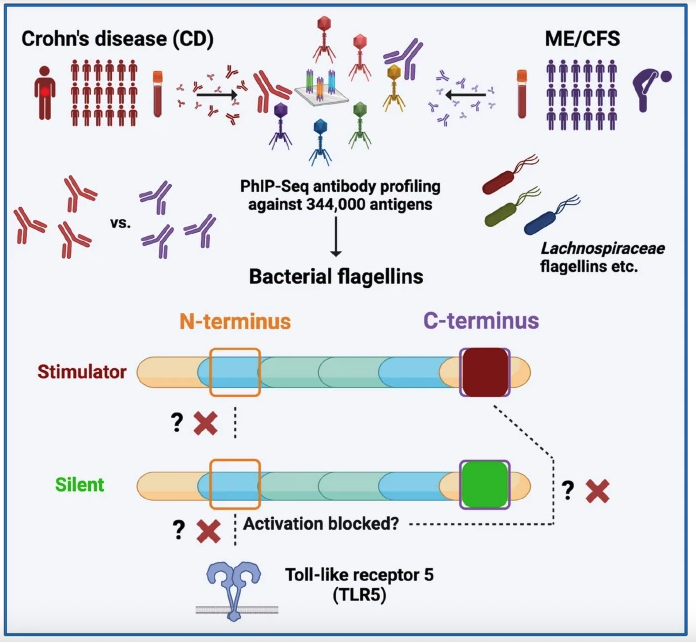
A study published in the journal Microbiome examined systemic antibody responses against bacterial flagellins in people with Crohn’s disease and myalgic encephalomyelitis/chronic fatigue syndrome, commonly known as ME/CFS. The researchers found that the two conditions share certain patterns of immune reactivity but also display important differences.
Why study bacterial flagellins?
Flagellins are the proteins that form bacterial flagella—the tail-like structures that enable many bacteria to move. They are among the microbial components most readily recognised by the human immune system.
This recognition partly takes place through Toll-like receptor 5, or TLR5. TLR5 is an important receptor of the innate immune system and is widely expressed in the intestinal environment. By recognising specific regions of bacterial flagellins, it helps the body detect microorganisms and initiate an appropriate immune response.
Flagellins can be grouped according to how they interact with TLR5:
- Stimulator flagellins bind to and activate TLR5.
- Silent flagellins can bind to TLR5 but activate it only weakly.
- Evader flagellins, which are found in certain pathogens, avoid recognition by TLR5 through changes in the relevant binding region.
Antibodies that bind to particular regions of flagellins could potentially interfere with these interactions. Understanding exactly which regions are recognised by antibodies may therefore help researchers uncover how immune regulation differs between health and disease.
Comparing two different chronic conditions
Elevated antibody responses against flagellins from the gut microbiota have previously been observed in both Crohn’s disease and ME/CFS.
Crohn’s disease is a chronic inflammatory bowel disease characterised by inflammation of the digestive tract. ME/CFS is a complex chronic condition associated with severe fatigue, post-exertional malaise and a range of other symptoms. Despite their very different clinical presentation, both conditions have been associated with changes in the gut microbiota, impaired intestinal barrier function and increased exposure of the immune system to microbial components.
However, it has remained unclear whether patients with these conditions recognise the same types and regions of bacterial flagellins—and whether their antibody responses could have similar functional consequences.
To investigate this, the research team analysed existing antibody-profile data from patients with Crohn’s disease and ME/CFS and compared them with matched healthy controls. The study included samples from the 1000IBD cohort, the Lifelines-DEEP population cohort and the UK ME/CFS Biobank.
The researchers used phage-display immunoprecipitation sequencing, or PhIP-Seq, a high-throughput method that makes it possible to examine antibody reactivity against hundreds of thousands of peptide antigens simultaneously. This allowed them to identify the precise regions of bacterial flagellins targeted by circulating antibodies.
Shared antibody responses—and important differences
The results showed that patients with both Crohn’s disease and ME/CFS had elevated antibody responses against specific flagellin regions compared with healthy individuals.
In both conditions, antibodies frequently recognised the N-terminal region of flagellins from Lachnospiraceae, a family of bacteria commonly found in the human gut. The antibody-bound sequences were more similar to stimulator and silent flagellins than to evader flagellins.
This shared response could be important because the N-terminal region contains the motif through which flagellins bind to TLR5. The researchers propose that antibodies targeting this region may interfere with normal TLR5 binding. If this occurs, flagellins from commensal bacteria could become less readily recognised by the innate immune system, potentially altering the balance between innate and adaptive immune responses.
The study also identified a notable difference between the two diseases. Antibody binding to the C-terminal region of flagellins was more prevalent in Crohn’s disease than in ME/CFS. In Crohn’s disease, these antibody-bound sequences also showed greater similarity to stimulator flagellins.
The C-terminal region contributes to the activation of TLR5. Stronger antibody responses against this region in Crohn’s disease could therefore reflect or contribute to a different form of immune dysregulation. This finding may help researchers understand why the two conditions share some microbiome-related immune features but produce very different clinical manifestations.
What could these findings mean?
The results offer a more detailed picture of how the adaptive immune system responds to gut bacterial proteins in chronic disease. Rather than showing only that anti-flagellin antibodies are elevated, the study identifies the specific parts and types of flagellins recognised by these antibodies.
These patterns could eventually help support the development of serological biomarkers for Crohn’s disease and ME/CFS. However, further research is required before they can be used in diagnosis or clinical decision-making.
The findings also generate new questions about disease mechanisms. Future studies will need to determine whether these antibodies directly alter flagellin–TLR5 interactions and, if so, how this affects immune signalling, intestinal barrier function and the relationship between the host and the gut microbiota.
Advancing DarkMatter research
The study contributes directly to the objectives of the Horizon Europe project ID-DarkMatter-NCD, which investigates how infectious agents and microbiome-related immune responses may contribute to the development of immune-mediated noncommunicable diseases.
By mapping antibody responses to microbial antigens in fine detail, the research helps reveal previously hidden interactions between the microbiome and the immune system—the biological “dark matter” that may connect environmental exposures with chronic disease.
The study was conducted by Arno R. Bourgonje, Nicolai V. Hörstke, Michaela Fehringer, Gabriel Innocenti and Thomas Vogl. Arno R. Bourgonje is affiliated with the Icahn School of Medicine at Mount Sinai and the University Medical Center Groningen. Nicolai V. Hörstke, Michaela Fehringer, Gabriel Innocenti and Thomas Vogl are based at the Center for Cancer Research at the Medical University of Vienna.
The research was supported in part by the Horizon Europe ID-DarkMatter-NCD consortium, alongside funding from the European Research Council, the ME/CFS Lines Consortium, the Netherlands Organisation for Health Research and Development and the Dutch Research Council.
Read the full open-access publication:
Systemic antibody responses against gut microbiota flagellins implicate shared and divergent immune reactivity in Crohn’s disease and chronic fatigue syndrome