

Why do people respond differently when exposed to the same infectious agent? Age, previous exposure, vaccination and health status all play important roles. However, part of the answer is also written in our genes.
A new study supported by the Horizon Europe ID-DarkMatter-NCD project examines how genetic differences in human leukocyte antigen class II—or HLA-II—molecules influence the immune system’s capacity to recognise pathogens.
Published in Nature Communications, the study brings together immunopeptidomics, antibody profiles and health data from large population cohorts. The results indicate that the breadth of peptides presented by an individual’s HLA-II molecules helps shape antibody responses and can influence susceptibility to several infectious diseases.
HLA-II molecules: presenting evidence of infection
When a virus, bacterium or other infectious agent enters the body, the immune system must recognise that it represents a potential threat and develop an effective response.
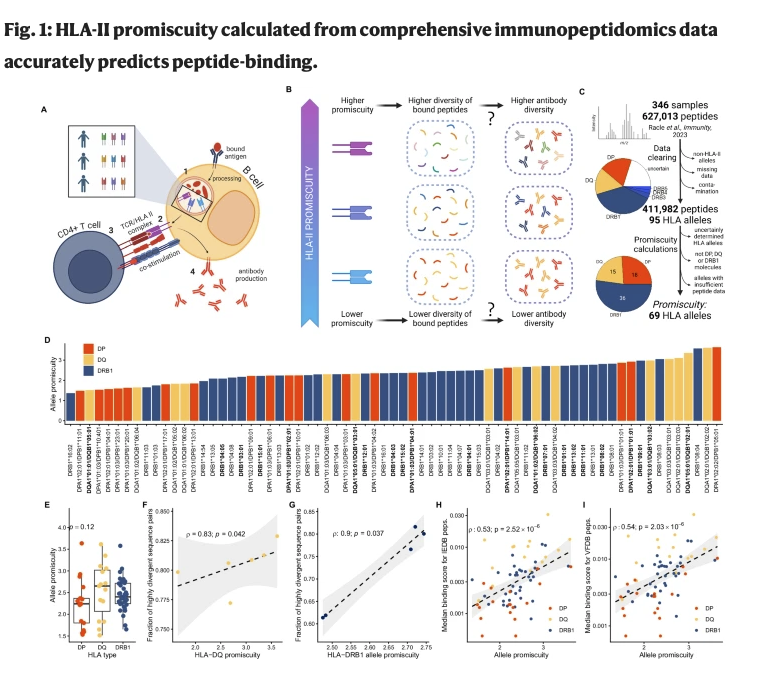
HLA-II molecules play a central role in this process. They bind short fragments of proteins, known as peptides, and display them on the surface of specialised immune cells. These peptides can then be inspected by CD4+ helper T cells.
Recognition of a peptide–HLA-II complex by helper T cells supports the activation and proliferation of B cells. These B cells can subsequently develop into cells that produce highly specific antibodies against the infectious agent.
HLA-II molecules therefore act as molecular display platforms. The range of peptides they can present influences which microbial proteins become visible to the adaptive immune system.
Generalists and specialists
The genes encoding HLA-II molecules are among the most diverse in the human genome. Thousands of different variants exist across the human population, and these variants differ substantially in the peptides they can bind.
Some HLA-II molecules can bind and present a broad variety of peptide sequences. The researchers describe these as generalist variants. Other HLA-II molecules recognise a more restricted selection of peptides and can be considered specialists.
In scientific terminology, the capacity to bind many different peptides is known as peptide-binding promiscuity. In this context, “promiscuity” simply describes the breadth and flexibility of molecular binding. It does not indicate whether a particular HLA-II variant is inherently better or worse.
Until now, it has remained unclear how strongly these differences affect antibody production and an individual’s overall susceptibility to infectious disease.
Combining molecular and population-scale evidence
The researchers developed a measure of HLA-II peptide-binding diversity based on one of the most comprehensive immunopeptidomics datasets available. The dataset included more than 627,000 peptide–HLA-II pairs.
This allowed the team to calculate peptide-binding diversity for 69 HLA-II variants across the three principal HLA-II groups: HLA-DP, HLA-DQ and HLA-DRB1. The measure was also tested against independent datasets containing peptides from adeno-associated viruses and SARS-CoV-2.
The researchers then combined this information with antibody profiles from approximately 1,500 people from the Lifelines-DEEP and 1000IBD cohorts. These profiles had been generated using phage-display immunoprecipitation sequencing, or PhIP-Seq—a high-throughput method that can detect antibodies against hundreds of thousands of peptide antigens.
Finally, the team examined medical information from the UK Biobank, a population resource containing genetic and health data from around half a million participants. This made it possible to investigate whether HLA-II binding diversity was associated not only with laboratory measurements of antibody responses but also with real-world infection outcomes.
Broader peptide presentation is linked to pathogen-specific antibodies
The first major finding was that HLA-II variants with broader peptide-binding repertoires were more frequently associated with the presence of antibodies against proteins from pathogens.
This relationship was specific to pathogens. The researchers did not observe the same significant association for proteins derived from non-pathogenic microorganisms.
The findings support a plausible biological mechanism: an HLA-II molecule able to present a wider variety of pathogen-derived peptides may increase the likelihood that helper T cells recognise an infectious agent and provide the support required for an effective antibody response.
Importantly, the study shifts attention away from individual HLA-II variants alone. It suggests that their broader functional characteristics—particularly the diversity of peptides they can display—may help explain differences in immune protection.
Lower susceptibility to several common infections
The researchers next asked whether broader peptide presentation was associated with infection outcomes in the UK Biobank.
Participants were grouped according to the peptide-binding diversity of their HLA-DRB1 molecules. Those in the group with the broadest binding repertoires had 5.6% lower odds of having at least one severe infectious disease requiring hospitalisation than those in the group with the narrowest repertoires.
The association remained significant after the researchers accounted for factors including age, sex, ancestry, immunodeficiency and individual HLA variants previously linked to infection risk.
Higher HLA-DRB1 peptide-binding diversity was also associated with a reduced incidence of eight groups of infectious diseases. These included viral and bacterial skin infections, herpes zoster, fungal infections and lower respiratory tract infections.
The largest difference was found in a diagnostic group dominated by genital warts caused by human papillomavirus. People in the highest 10% for HLA-DRB1 peptide-binding diversity had a lifetime incidence more than 45% lower than those in the lowest 10%.
The study also found reductions of approximately 16% for viral skin warts, 14% for herpes zoster and 14% for local bacterial infections of the skin and soft tissues.
These results do not mean that HLA-II type alone determines whether someone will develop an infection. Exposure, vaccination, behaviour, age, underlying health and many other immune mechanisms remain important. Rather, HLA-II peptide-binding diversity appears to be one inherited factor contributing to differences in susceptibility.
A more nuanced picture of immune protection
A broad binding repertoire was not advantageous in every situation examined.
The study found that more selective HLA-DRB1 variants were associated with a lower incidence of HIV infection. The authors propose that specialist variants may sometimes be particularly effective against less common or evolutionarily distinct pathogens because they can mount a more narrowly targeted response.
However, this part of the analysis focused on a single pathogen and therefore requires further investigation.
Together, the findings suggest an evolutionary trade-off. Generalist HLA-II molecules may provide broad protection against pathogens that human populations encounter frequently, while specialist molecules could offer advantages against particular, less common threats.
This balance may help explain why such extensive HLA diversity has been maintained throughout human evolution.
Potential implications for vaccination and personalised risk assessment
The researchers also analysed data from an influenza vaccination cohort. Among participants aged 60–79, higher HLA-DRB1 peptide-binding diversity was associated with stronger antibody responses following vaccination.
This raises the possibility that HLA-II binding characteristics could help explain why vaccines produce different levels of protection in different people. Further studies will be needed to determine whether the same relationship applies to other vaccines and age groups.
More broadly, HLA-II peptide-binding diversity could potentially contribute to future biomarkers for susceptibility to infectious disease. Unlike approaches that focus on individual HLA variants, this measure captures a functional property shared across different variants: the breadth of microbial peptides they can present.
The findings are not yet ready for clinical use. The antibody-profiling method primarily detects linear peptide regions and may miss antibody targets that depend on a protein’s three-dimensional structure. Some of the peptide-binding estimates also rely on computational assignment and will require validation using additional experimental datasets.
Further research must also examine how HLA-II binding diversity interacts with other genetic, immunological and environmental factors.
Revealing part of the immune system’s “dark matter”
The study contributes directly to the objectives of ID-DarkMatter-NCD, which investigates how infectious agents and immune responses interact with genetic and environmental factors to influence disease susceptibility.
Three of the senior researchers involved—Thomas Vogl, Máté Manczinger and Alexandra Zhernakova—are partners in the ID-DarkMatter-NCD consortium. The study also connects several areas central to the project: HLA genetics, antibody repertoires, microbial antigens and individual differences in responses to infection.
By moving beyond associations with individual HLA variants and examining their functional peptide-binding capacity, the research helps reveal some of the previously hidden mechanisms that shape immune protection.
The findings offer a clearer picture of how inherited variation can influence what the immune system sees, which antibodies it produces and how effectively it responds to different infectious threats.
About the study
The research was conducted by Bettina Magyari, Anna Tácia Fülöp, Dávid Kókai, Franciska Tóth, Gergő Mihály Balogh, Sergio Andreu-Sánchez, Gabriel Innocenti, Rinse K. Weersma, Jingyuan Fu, Csaba Pál, Alexandra Zhernakova, Thomas Vogl and Máté Manczinger.
The researchers are affiliated with the HUN-REN Biological Research Centre and the University of Szeged in Hungary, the Medical University of Vienna in Austria, and the University Medical Center Groningen and University of Groningen in the Netherlands.
The study was published in Nature Communications, volume 17, article 9422 (2026).
Read the full open-access publication:
HLA-II peptide-binding diversity shapes humoral immune responses and susceptibility to infections