

Fatigue is one of the most common and debilitating symptoms experienced by people with inflammatory bowel disease (IBD). Yet its underlying biological causes remain poorly understood. A new study involving researchers from the ID-DarkMatter-NCD consortium has used large-scale antibody profiling to investigate whether immune responses to microorganisms could provide clues to the mechanisms behind fatigue in IBD.
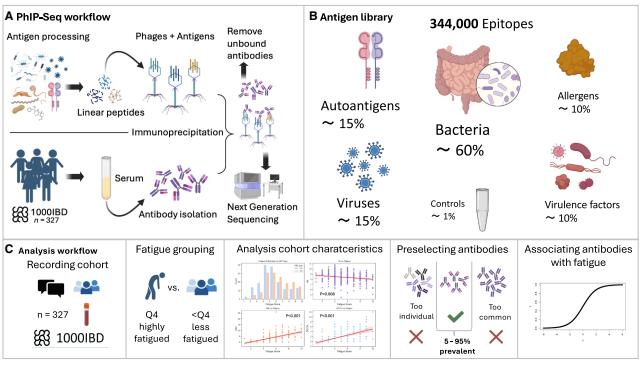
Published in iScience, the study examined antibody responses to approximately 344,000 peptide antigens in 327 people with Crohn’s disease or ulcerative colitis. The researchers observed recurring differences in responses to antigens from Epstein–Barr virus, influenza virus and Staphylococcus aureus across groups with different levels of fatigue.
However, the results must be interpreted carefully: no individual antibody association remained statistically significant after correction for the very large number of comparisons, and additional analyses indicated that some of the observed patterns could have occurred by chance. The findings therefore do not establish that these microorganisms cause fatigue. Instead, they generate hypotheses for future studies and illustrate both the potential and the challenges of using high-dimensional immune data to investigate complex symptoms.
Fatigue: a major but poorly understood burden in IBD
Inflammatory bowel disease is a collective term for chronic inflammatory conditions of the digestive tract, principally Crohn’s disease and ulcerative colitis. In addition to abdominal pain, diarrhoea and rectal bleeding, many people with IBD experience persistent fatigue.
Fatigue affects an estimated 70–80% of patients with active IBD and approximately 40–50% of those whose disease is in remission. It can affect physical energy, concentration, mental health, social participation and the ability to work. Importantly, fatigue may continue even when intestinal inflammation is clinically well controlled.
Its causes are likely to be multifactorial. Active inflammation and anaemia can contribute, but they do not explain all cases. Nutritional deficiencies, sleep disturbance, psychological factors, medication, changes in the gut microbiome and altered immune activity may also play a role.
The new study explored one particular possibility: whether fatigue is accompanied by distinctive systemic antibody responses to bacterial or viral antigens.
Using antibodies as a record of immune exposure
Antibodies are produced by the immune system in response to biological targets known as antigens. The collection of antibodies circulating in a person’s blood can contain traces of previous and ongoing encounters with viruses, bacteria, food components and the body’s own proteins.
Investigating this extensive antibody repertoire could therefore help researchers understand how past microbial exposures and immune responses relate to chronic inflammatory diseases and their symptoms.
Conventional laboratory techniques generally test antibody responses to only one or a few antigens at a time. In this study, the researchers used phage-display immunoprecipitation sequencing, or PhIP-Seq, a high-throughput method that can screen antibody binding against hundreds of thousands of peptide fragments simultaneously.
The method uses bacteriophages—viruses that infect bacteria—to display selected peptides on their surfaces. When these phages are mixed with a blood sample, antibodies can bind to peptides they recognise. The antibody-bound phages are then isolated and identified through DNA sequencing. This produces a broad profile of the peptide antigens recognised by each participant’s antibodies.
For this study, the library contained approximately 344,000 rationally selected peptides representing microbial, food-related and human antigens.
Examining antibody responses in 327 people with IBD
The analysis included 327 participants from the Groningen 1000IBD cohort:
- 156 participants had Crohn’s disease;
- 171 had ulcerative colitis;
- 198 participants, or 60.6%, were women.
Participants reported their level of fatigue close to the time at which their blood sample was collected. The researchers divided the fatigue scores into groups and compared antibody patterns between participants with different levels of fatigue.
Because fatigue can be strongly influenced by disease activity and anaemia, the researchers also conducted separate analyses in participants who were in clinical and biochemical remission and did not have anaemia. Statistical models accounted for age, sex and smoking status.
As expected, fatigue was associated with clinical disease activity. Participants with Crohn’s disease reported higher median fatigue scores than those with ulcerative colitis, while smokers reported more fatigue than non-smokers. Women also reported slightly higher fatigue scores than men. Haemoglobin levels showed a weak inverse association with fatigue, meaning that lower haemoglobin tended to be accompanied by greater fatigue.
Nevertheless, fatigue remained common among participants whose disease was in remission. More than half—51%—of the remission subgroup reported at least moderate fatigue, compared with 73% of participants with active disease and/or anaemia. This reinforces the clinical observation that controlling intestinal inflammation does not necessarily eliminate fatigue.
No single antibody provided a robust fatigue marker
The researchers initially examined whether individual antibody-bound peptides were associated with fatigue.
None of these individual peptide associations remained statistically significant after false discovery rate correction. This correction is essential when hundreds of thousands of statistical comparisons are made, because some apparently significant findings will otherwise occur simply by chance.
The team also grouped peptides into eight larger, predefined antigen libraries, including gut microbiome antigens, pathogenic bacteria, bacteriophages, probiotics and allergens. Some groups showed nominal associations, but none remained significant after correction, and the directions of the associations were inconsistent across analyses.
A further comparison with antibody responses previously reported in myalgic encephalomyelitis/chronic fatigue syndrome, or ME/CFS, likewise found no peptide that remained significantly associated with fatigue after multiple-testing correction.
The study therefore did not identify a validated antibody biomarker for fatigue in IBD.
Recurring patterns involving Epstein–Barr virus
Although individual antibodies did not yield statistically robust associations, the researchers explored whether groups of antibodies directed against antigens from the same microorganism displayed recurring patterns.
Several of the most prominent patterns involved Epstein–Barr virus (EBV), a widespread herpesvirus that establishes lifelong latency following infection.
More fatigued participant groups showed a lower prevalence of antibodies recognising the EBV early antigen protein D, also known as BMRF-1 or EA-D. This difference was most evident among participants with Crohn’s disease.
Conversely, responses to some EBV nuclear antigens associated with the virus’s latent phase were more prevalent in certain groups with greater fatigue:
- EBNA-1 responses were more common in fatigued groups with Crohn’s disease;
- EBNA-3A and EBNA-3C responses were more prominent in some fatigued groups with ulcerative colitis, particularly among participants in remission.
These differences should not be interpreted as evidence of EBV reactivation or as proof that EBV causes fatigue. The study did not directly measure viral activity, viral load, T-cell responses or cytokine signalling. It also could not distinguish between different stages of EBV infection or immune memory.
Instead, the findings suggest that immune recognition of certain EBV antigens may differ across fatigue groups within an IBD population. Whether this reflects fatigue itself, the underlying bowel disease, treatment, previous infections or general differences in immune exposure remains unresolved.
The observation is nevertheless of scientific interest because EBV-related immune responses have previously been investigated in several chronic immune-mediated conditions. Future studies will need appropriate control groups and direct virological measurements to determine whether the patterns are genuinely related to fatigue.
Signals associated with influenza virus antigens
The analysis also revealed recurring differences in antibody responses to the influenza matrix proteins M1 and M2.
Antibodies recognising these proteins were more prevalent in several fatigued groups. The pattern was particularly noticeable in ulcerative colitis and, in some comparisons, among participants whose disease was in remission. Patterns in Crohn’s disease were less consistent.
M1 is an important structural protein in the influenza virus, while M2 forms an ion channel involved in viral entry and maturation. The external region of M2 can also induce cross-reactive antibodies and is being investigated in influenza vaccine research.
At present, there is no direct evidence that antibody responses to M1 or M2 contribute to fatigue in people with IBD. The patterns could reflect previous influenza infection, vaccination history, immune-modulating treatment or other differences in immune memory. Information on all these factors was not available for the present analysis.
Accordingly, the findings identify a possible direction for research rather than demonstrating a biological mechanism.
A possible bacterial signal
Among the bacterial antigens, the researchers observed an increased prevalence of antibodies targeting clumping factor B, or ClfB, from Staphylococcus aureus in some groups with greater fatigue. This pattern was particularly visible among participants with active ulcerative colitis.
ClfB is a bacterial surface protein that helps S. aureus attach to epithelial tissues, especially in the nose and skin. One possible explanation is that compromised epithelial barriers or inflammation could affect the body’s exposure and immune response to bacterial antigens. However, S. aureus is not generally considered a central microorganism in IBD development, and the association did not remain robust in the study’s permutation analyses.
The observed ClfB response therefore also requires independent validation before any conclusions can be drawn about its relationship with fatigue.
Different patterns from those previously observed in ME/CFS
Previous PhIP-Seq research has identified increased antibody responses to bacterial flagellins in people with ME/CFS. Flagellins are proteins that form part of the structures bacteria use for movement.
Because fatigue is a defining feature of ME/CFS and is also common in IBD, the researchers investigated whether similar flagellin-related responses were associated with fatigue in the IBD cohort. They did not find significant differences between IBD participants with different fatigue levels.
This may indicate that fatigue can involve different immune processes in different diseases. However, it could also reflect differences in study design, patient populations or how fatigue was measured. More detailed and directly comparative research is needed before disease-specific conclusions can be reached.
Why the results require careful interpretation
The authors emphasise that this was an exploratory, hypothesis-generating study. Several limitations are particularly important.
First, the study did not include a matched control group with both PhIP-Seq data and equivalent fatigue measurements. It was therefore not possible to determine whether the antibody patterns were specific to fatigue, to IBD, or to immune exposure more generally.
Second, fatigue was assessed using a one-dimensional self-reported scale. Fatigue includes physical, cognitive, emotional and motivational dimensions that cannot be fully captured by a single score. Future studies could use validated multidimensional instruments and investigate whether different types of fatigue have different biological associations.
Third, although the analyses accounted for age, sex and smoking, other potential confounding factors were not comprehensively available. These include:
- previous and recent infections;
- vaccination history;
- disease duration;
- sleep disturbances and depression;
- treatment history;
- corticosteroid, biologic and immunomodulatory medication use.
Such factors can influence both fatigue and antibody responses.
The size of the antigen library also presents a statistical challenge. Testing more than 300,000 peptides in a cohort of 327 participants makes it difficult to detect reliable peptide-level associations after correcting for multiple comparisons. When the researchers tested whether the aggregate patterns exceeded those produced by randomly assigning fatigue labels, the results were not significant. This means that comparable signals could arise through random variation.
Finally, PhIP-Seq mainly detects antibodies recognising linear protein fragments. It cannot comprehensively detect antibodies that recognise complex three-dimensional protein structures or non-protein antigens such as lipids and glycans.
A foundation for more targeted research
Despite these limitations, the study demonstrates how high-throughput antibody profiling can be applied to a specific and clinically important symptom rather than only to disease diagnosis.
The results point towards several priorities for future research:
- studying larger, independent cohorts;
- including healthy controls and people with fatigue who do not have IBD;
- using multidimensional fatigue assessments;
- following patients over time;
- collecting detailed infection, vaccination and medication histories;
- combining antibody profiles with measurements of viral activity, cytokines and cellular immune responses;
- validating candidate antibody patterns with complementary laboratory methods.
Longitudinal studies will be particularly valuable. Following patients over time could reveal whether changes in antibody responses precede, accompany or follow changes in fatigue severity.
Connecting infections, immune responses and chronic disease
The study closely reflects the wider objectives of ID-DarkMatter-NCD: to investigate how infectious agents, microbial exposures, immune responses and genetic factors contribute to immune-related non-communicable diseases.
ID-DarkMatter-NCD brings together expertise across several chronic conditions, including inflammatory bowel disease, rheumatoid arthritis, systemic lupus erythematosus, multiple sclerosis, post-COVID condition and ME/CFS. A central part of this work is the use of advanced immunological and multi-omics technologies to identify both shared and disease-specific mechanisms.
Several authors of the new publication are closely connected to this effort. Thomas Vogl of the Medical University of Vienna coordinates ID-DarkMatter-NCD and contributes expertise in systems immunology and PhIP-Seq. Rinse Weersma and Arno Bourgonje contribute clinical and scientific expertise in inflammatory bowel disease. The work of Arno Bourgonje and Rinse Weersma was supported by ID-DarkMatter-NCD, while Thomas Vogl acknowledged both project support and his role as consortium coordinator.
From intriguing patterns to testable hypotheses
This study does not provide a diagnostic test for fatigue and does not show that EBV, influenza virus or Staphylococcus aureus causes fatigue in IBD. Its main contribution is more fundamental: it provides a systematic exploration of how a very broad range of antibody responses relates to a complex and insufficiently understood clinical symptom.
The recurring antigen-level patterns offer starting points for more focused research, while the absence of robust individual antibody associations provides an equally important lesson. Complex symptoms such as fatigue are unlikely to be explained by a single immune marker. Understanding them will require larger cohorts, better clinical phenotyping, longitudinal observation and careful integration of different layers of biological and clinical data.
By making these challenges visible and defining concrete hypotheses for validation, the study takes another step towards understanding why fatigue persists in so many people with IBD—even when the disease itself appears to be under control.
The full open-access publication is available in iScience: Systemic antibody responses against bacterial and viral antigens associate with fatigue in patients with inflammatory bowel disease. The bibliographic record is also available through PubMed.